
Pipeline Inflation
Where Your Demand Gen Is Quietly Breaking
The sales teams with the strongest forecast accuracy and shortest cycles figured out one thing first: qualification before conversation.
They are not waiting for a demo request to understand what a prospect actually needs. They are collecting real intent signals before the first call even happens. The result: reps selling to prospects who are genuinely ready, forecast accuracy that actually holds, and cycles that move significantly faster.
The gap between 13% MQL-to-SQL conversion and 87% is not luck. It is method.
13%of MQLs ever reach Sales Qualified Lead status.
The other 87 are pipeline inflation in motion.
Source: First Page Sage, MQL to SQL Conversion Rate by Industry, 2025
Why Most Teams Are Still Stuck at 13%
Teams ran more campaigns in 2026, increased spend, deployed AI personalization, and hit their MQL targets. Dashboards looked healthy. Pipeline coverage looked strong. Revenue quality did not follow.
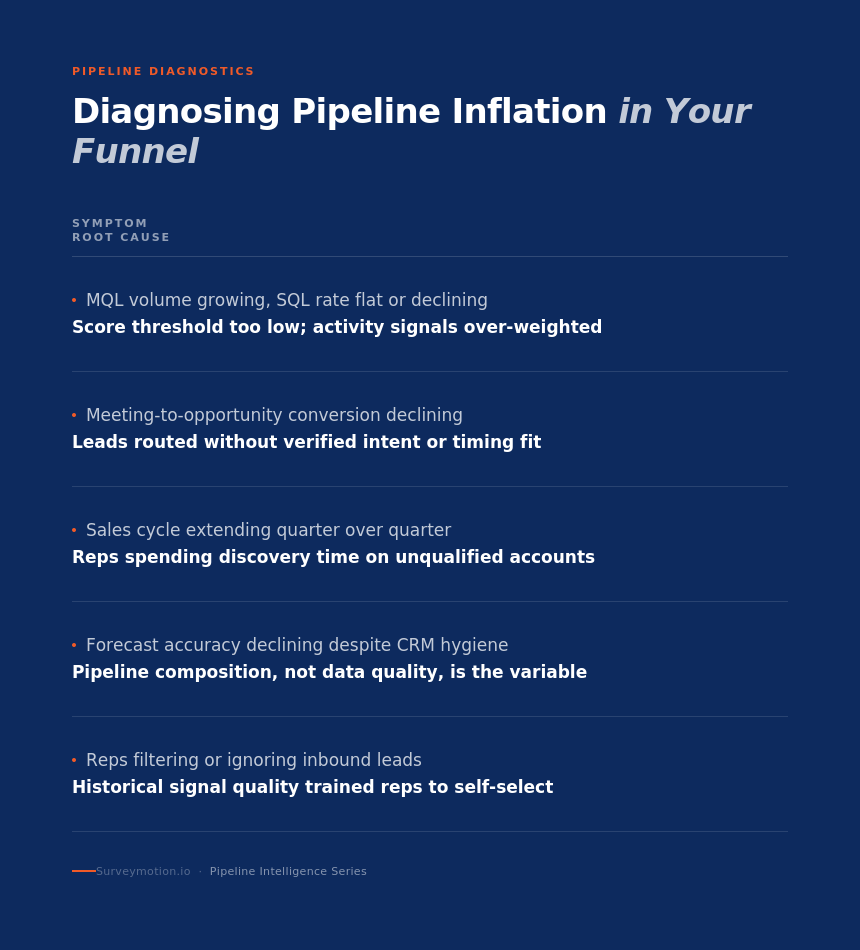
Meeting-to-opportunity rates dropped. Sales cycles stretched. Reps started filtering leads. Forecasts became less reliable.
The problem was never budget or sales execution. Reps are not underperforming against qualified demand. They are triaging a queue that was never built for conversion in the first place.
What most teams are dealing with is a pipeline composition problem. The structure of the MQL pool has been quietly corrupted by low-intent signals normalized over time.
How Inflation Enters the Funnel
Pipeline inflation is not a single failure point. It accumulates across three structural layers:
01 · The Scoring Layer
Most MQL scoring models were built around behavioral activity: page visits, email opens, content downloads, webinar attendance. These signals indicate engagement, not intent. A prospect who downloads three whitepapers over six weeks has told you they are curious. They have not told you they have a budget, a timeline, or a problem they need to solve.
When curiosity is scored the same as active evaluation, your threshold becomes meaningless. Score inflation follows. More MQLs cross the line, and the denominator on your SQL conversion rate quietly expands.
Key Insight
The gap between “content consumption” and “active buying intent” is where most pipeline inflation originates. Engagement scoring cannot close that gap. Only direct signal collection can.
02 · The Routing Layer
Even when marketing identifies a warm signal, routing logic often removes it. Leads are segmented by firmographic fit and assigned to reps by territory. But the rep in that territory has 60 leads in queue and will triage toward the ones most likely to pick up the phone.
No one in the process is making a wrong decision individually. The system itself produces the outcome: leads that were never going to convert get worked, velocity slows, and the pipeline number holds while close rates decline.
03 · The Measurement Layer
This is where inflation becomes self-reinforcing. When teams measure pipeline in volume terms (total opportunities, pipeline coverage ratio, MQL count) they create incentives to generate more of what is being counted. Campaign teams hit targets. Dashboards stay green.
The problem surfaces downstream: in sales cycles that extend by weeks, in deals that stall at proposal, in win rates that quietly compress quarter over quarter.
Why Standard Fixes Often Make It Worse
The three most common responses to a pipeline quality problem are: adding more top-of-funnel volume, tightening MQL thresholds, or investing in intent data overlays. Each addresses a symptom. None addresses the composition problem.
Adding volume
Generates more of the same signal mix. If 13% of your current MQLs convert, adding 200 more at the same quality floor produces 26 more SQLs and significantly more noise for your sales team to work through.
Tightening thresholds
Reduces volume but does not change what the signals mean. A prospect who scores 85 instead of 60 based on content engagement is not more likely to buy. They are more engaged with your content. These are different things.
Third-party intent overlays
Useful for identifying accounts researching your category, but category intent and vendor-specific intent are not equivalent. An account consuming content on “B2B survey tools” may be benchmarking, building a case study, or writing a competitor analysis. You do not know without asking.
What the Best Teams Do Differently
They embed qualification signal collection into the demand gen motion itself, rather than treating it as a separate SDR or sales step.
This means asking leads what they are actually trying to solve, where they are in their evaluation, what their timeline looks like, and whether there is organizational momentum behind the initiative — all of it collected inside the touchpoints they are already engaging with, before they reach the sales queue.
The outcome is not just better leads. It is a fundamentally different sales motion: shorter cycles, more reliable forecasts, and reps who trust the queue they are working from.
The Compound Cost of Not Fixing This
Pipeline inflation is not a quarterly problem. It is a compounding one.
When reps spend cycles on low-intent leads, two things happen simultaneously: close rates compress, and rep behavior changes. Experienced reps learn to distrust the queue. They build their own sourcing motions, spend more time on outbound, and become selective about inbound. Inbound lead follow-up speed declines. Response rates fall. Marketing interprets this as a rep performance problem and sends more leads. The cycle continues.
Over four to six quarters, this produces a team that has structurally opted out of the demand gen motion, a pipeline that is large but unreliable, and a forecasting problem that no amount of CRM hygiene will resolve. The data is accurate. The composition is just wrong.
You cannot forecast your way out of a pipeline composition problem. You can only solve it upstream, before leads enter the queue.
Where to Start
The diagnostic question is not “which channel is underperforming.” It is: what percentage of our MQLs had any direct intent signal before reaching sales?
For most teams, the answer is close to zero. Not because anyone made a wrong decision, but because the infrastructure to capture direct signal was never built into the funnel.
That is exactly what SurveyMotion is built for.
Instead of waiting for a demo request to reveal what a prospect actually needs, SurveyMotion embeds qualification questions directly into the touchpoints your leads are already engaging with: content, landing pages, nurture flows. Before a lead ever reaches your sales queue, you know what they are trying to solve, where they are in their evaluation, and whether there is real budget and timeline behind it.
The result is a sales team that stops triaging and starts selling. Shorter cycles, more reliable forecasts, and a pipeline where the 13% is a floor, not a ceiling. See how SurveyMotion fixes the composition problem upstream.
FAQs
What is survey-driven lead generation?
Survey-driven lead generation uses surveys to identify, qualify, and engage prospects by collecting both contact data and intent signals.
How does SurveyMotion qualify leads?
We match responses against your ICP, score them for buying intent, and deliver both survey leads and meeting-ready leads.
What’s the difference between a survey lead and a meeting lead?
- Survey Lead: Fits your ICP and completed the survey.
- Meeting Lead: Survey Lead with high buying intent—ready for a sales call.
Does SurveyMotion work for any industry?
While we can adapt to many verticals, our sweet spot is B2B SaaS companies selling to mid-market and enterprise buyers.
How long does it take to see results?
Most clients see their first qualified meetings booked within 2–3 weeks of campaign launch.